
SEC Suspends Trading in Magnitude International Ltd. Over Potential Manipulation
The full order can be found here
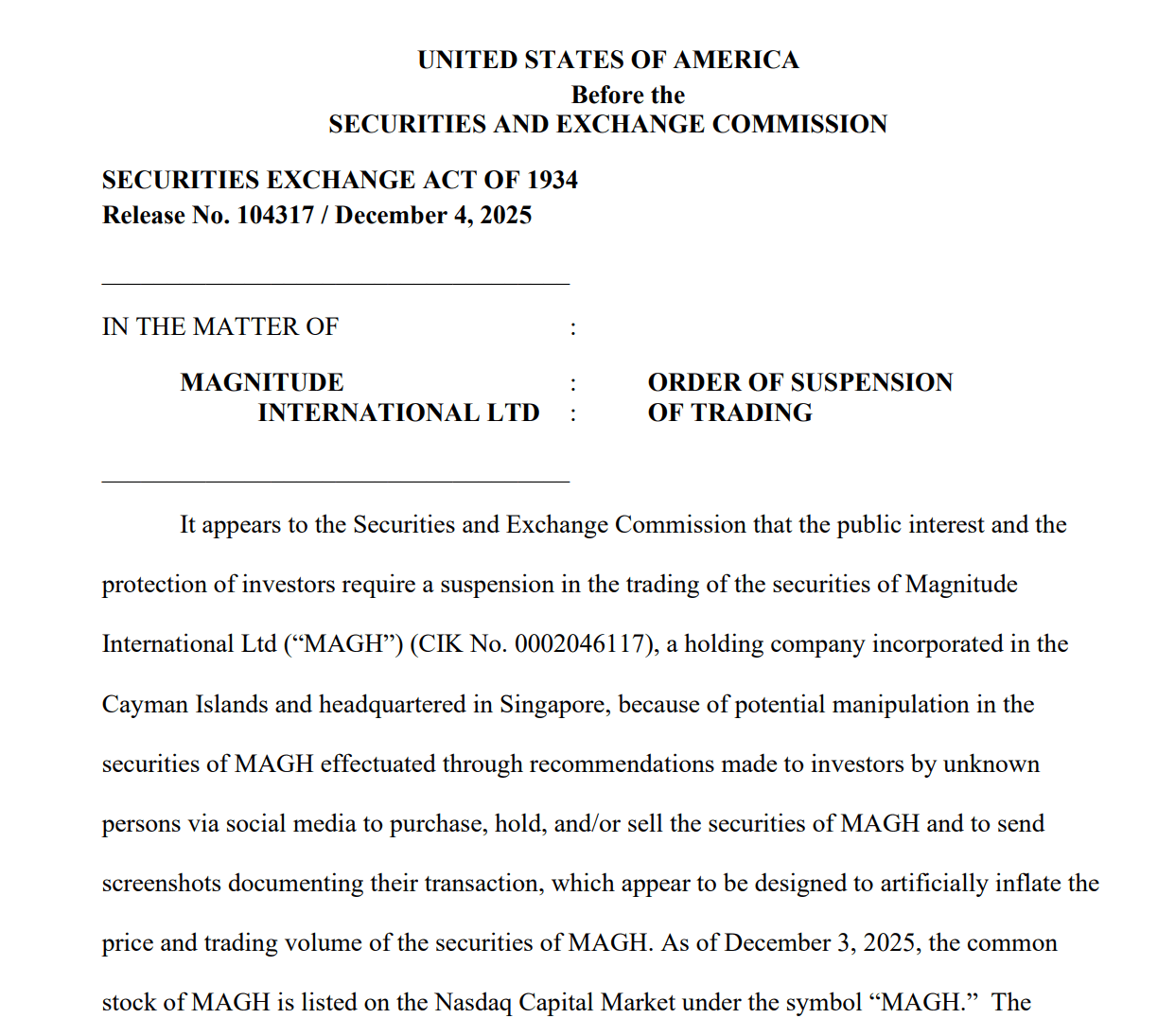
The Securities and Exchange Commission has imposed a 10-trading-day suspension on the securities of Magnitude International Ltd. (Nasdaq: MAGH), citing concerns that social-media–driven recommendations may have been used to artificially inflate the stock’s price and trading volume. Trading is halted from 4:00 a.m. ET on December 5, 2025, through 11:59 p.m. ET on December 18, 2025.
Magnitude International is described as a Cayman Islands holding company headquartered in Singapore, with its common stock listed on the Nasdaq Capital Market.
This action is not a routine exchange halt—it is a regulator-imposed stop under Section 12(k) of the Securities Exchange Act, a tool the SEC uses when it believes swift action is required to protect investors.
Why the SEC Acted
The order points to potential manipulation tied to online promotions urging investors to buy, hold, or sell MAGH shares and to post screenshots of their trades—activity the SEC believes may have been intended to inflate both price and volume.
Although the SEC provides limited detail, campaigns built around coordinated social-media “proof posts” and trading screenshots have been a recurring pattern in previous manipulation cases.
What This Means for Investors
When the suspension lifts, trading conditions may be significantly different:
Liquidity often declines after a regulatory halt.
Volatility typically increases, with wider spreads and sharper price swings.
Market participants may reduce exposure due to elevated legal and compliance risk.
A trading suspension also frequently precedes deeper regulatory scrutiny if the SEC uncovers credible evidence of manipulative schemes.
Bottom Line
The SEC’s order underscores a simple point: when regulators believe a stock’s trading activity is being artificially influenced—particularly through online promotion—they will intervene quickly. Investors should expect MAGH to reopen under heightened uncertainty and should be prepared for thinner liquidity and more volatile price action once trading resumes.